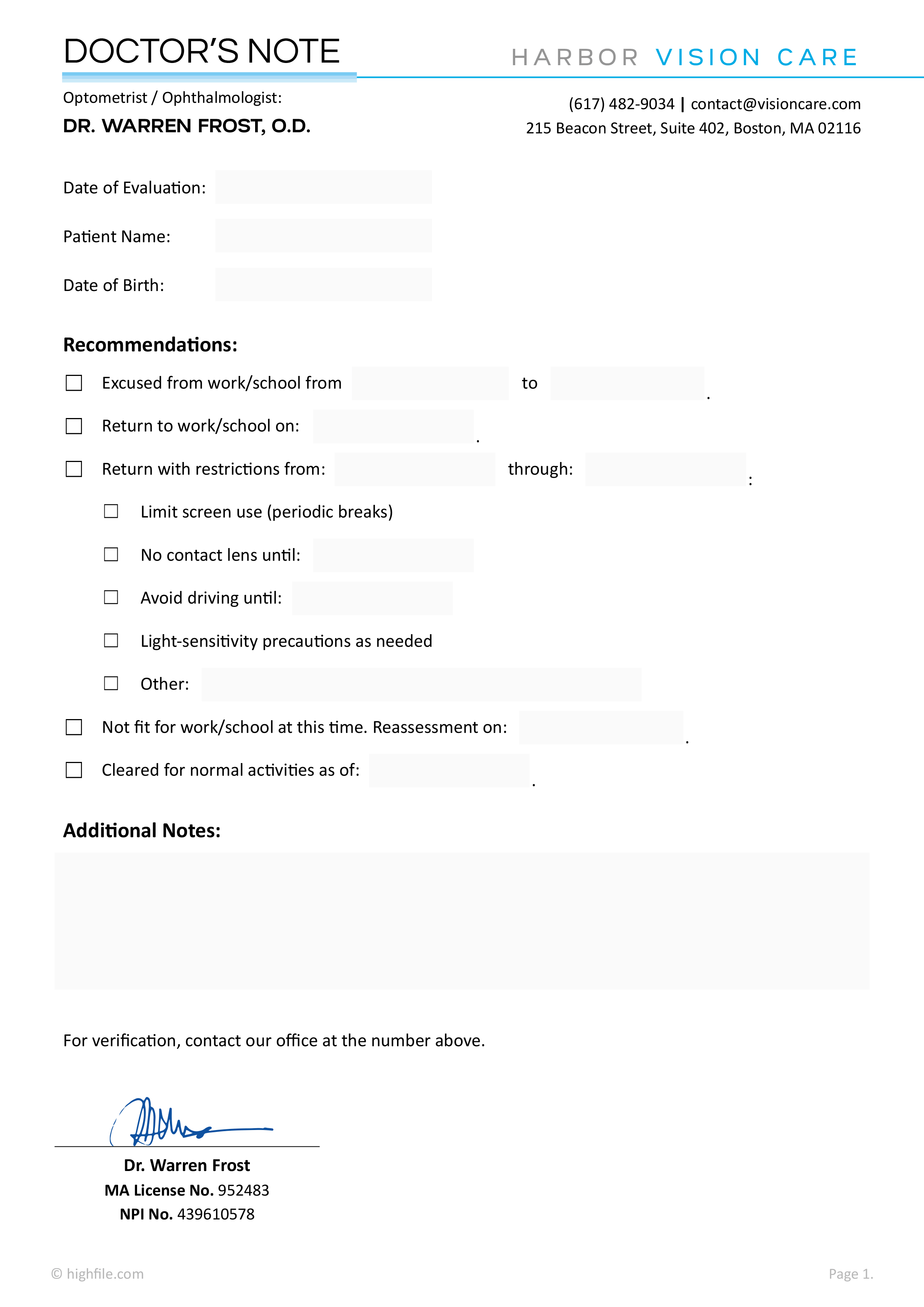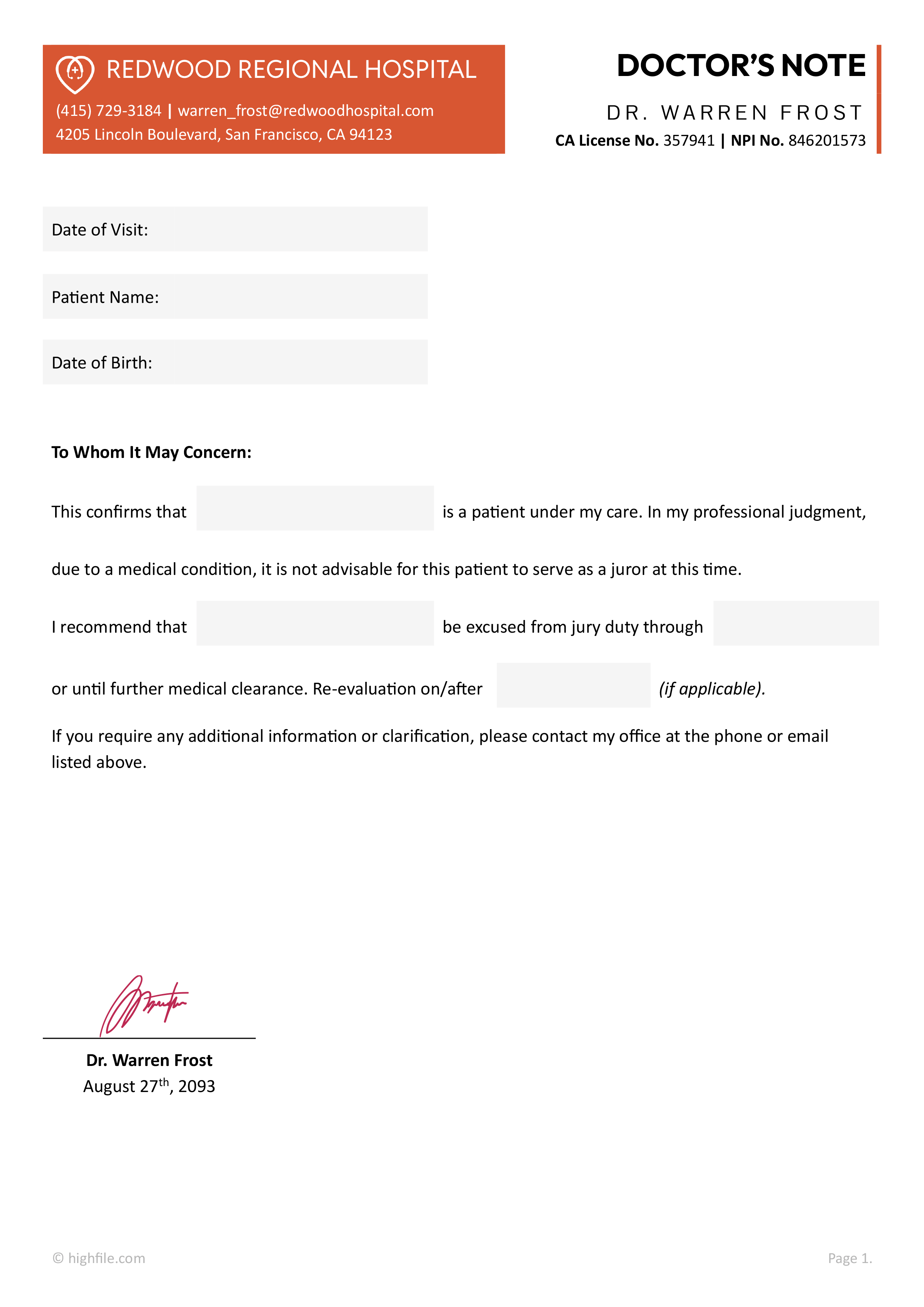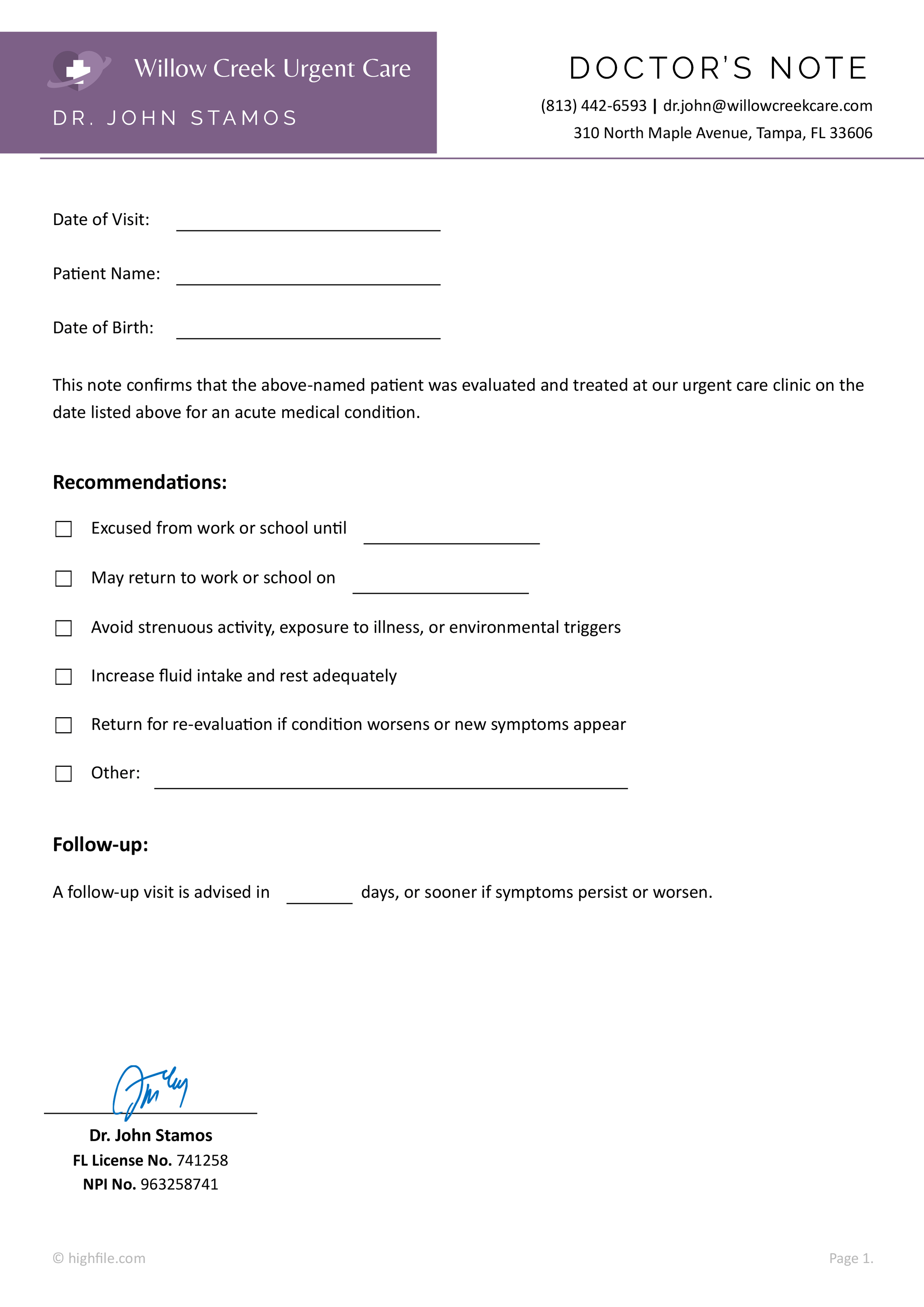




Letterhead and Provider Information
Begin with your contact details, including phone number and practice address, followed by name, credentials, and license number. These credentials provide recipients with the necessary details to verify the provider.
Date of Visit & Patient Information
Enter the date of the visit, along with the patient’s full name and date of birth. These details link the note to the correct individual and document when the clinical evaluation took place.
Confirmation Statement
State that the patient has been under your care for a mental health condition during the specified date range. This statement documents that the visit occurred and that your recommendations are based on a clinical assessment.
Recommendation
Select the option that best reflects your clinical guidance. Indicate whether the patient requires a defined period of rest, a scheduled follow-up evaluation, or other brief recommendations based on the patient’s current status.
Additional Notes
Use this section for additional remarks that support the recommendation and are not covered elsewhere in the note. Avoid including treatment details or diagnostic information to comply with HIPAA’s minimal necessary standards.
Verification
Include a short line inviting contact for verification or administrative questions. This allows the recipient to confirm authenticity without requesting additional medical details.
Signature and Date
Add your signature and the date to finalize the note. Print your name beneath the signature to identify yourself as the licensed healthcare provider.
Legal Considerations for Mental Health Adjustments
Individuals with mental health conditions are protected under a combination of federal and state laws that require reasonable adjustments in employment, education, and public services. At the federal level, the Americans with Disabilities Act (ADA) prohibits discrimination against individuals with mental health disorders such as anxiety, depression, bipolar disorder, and PTSD when these conditions substantially limit one or more major life activities. Employers with 15 or more employees must consider reasonable accommodations, including flexible scheduling, adjusted duties, or remote work, when supported by documentation that summarizes how the condition affects function. According to the Equal Employment Opportunity Commission (EEOC), employers may ask for documentation when a disability is not visible. However, the request should be limited to functional impact and accommodation needs, not diagnostic details.
In educational environments, both Section 504 of the Rehabilitation Act and the Individuals with Disabilities Education Act (IDEA) establish protections for students with mental health conditions. These laws require public schools and postsecondary institutions receiving federal funding to provide academic adjustments or support services when mental health concerns interfere with learning or access. If a student’s condition significantly impacts educational performance, an Individualized Education Program (IEP) may be developed under IDEA to provide targeted support.
States often have additional or expanded legal frameworks that reinforce or extend these federal protections. For instance, California’s Fair Employment and Housing Act (FEHA) applies to employers with as few as five employees and offers broader protections in some circumstances than the ADA. Similarly, New York State Human Rights Law prohibits discrimination based on mental disability and outlines obligations for reasonable accommodation in both employment and educational settings. Massachusetts law includes specific provisions to prevent discrimination due to mental illness and mandates that institutions take steps to accommodate individuals accordingly. These layered protections reflect a growing recognition of mental health as a civil rights issue and establish responsibilities for institutions to respond appropriately when accommodations are needed. Other states have similar laws that build on federal requirements and set their own standards for mental health accommodations.
FAQs
Yes, a mental health doctor’s note can often be obtained through a legitimate telehealth appointment with a licensed mental health provider. Many psychiatrists, psychologists, and other qualified clinicians offer virtual consultations that follow the same clinical standards as in-person visits. During an online session, the provider evaluates your symptoms, functioning, and medical history to determine whether a doctor’s note is appropriate. If clinically justified, the note is issued in a secure digital format and includes the provider’s credentials, date of evaluation, and relevant recommendations. The acceptance of an online note depends on the policies of the employer, school, or institution requesting it, and the provider must be licensed in the appropriate jurisdiction.
An employer can decline to accept a mental health doctor’s note in certain situations, depending on the purpose of the note and applicable workplace policies. For routine sick leave or attendance matters, employers often have specific documentation requirements, such as who may issue the note, the required format, and submission deadlines. If a doctor’s note does not meet these stated requirements, the employer may choose not to accept it, even when it reflects a legitimate clinical evaluation.
When a mental health doctor’s note is submitted to request time off, modified duties, or other workplace accommodations, the employer may review the note to determine whether it provides sufficient information to support the request. Employers may request clarification or additional documentation if the note is incomplete or unclear. In most cases, acceptance depends on whether the note explains how the condition affects work-related functioning and complies with the employer’s documentation standards.
References
- U.S. Disability Rights Law (ADA)
https://www.ada.gov
Official site explains ADA disability rights, protections, and compliance requirements. - Disability‑Related Inquiries and Medical Exams
https://www.eeoc.gov/laws/guidance/enforcement-guidance-disability-related-inquiries-and-medical-examinations-employees
EEOC explains ADA rules on disability inquiries and employee medical examinations. - Section 504 of the Rehabilitation Act of 1973
https://www.dol.gov/agencies/oasam/centers-offices/civil-rights-center/statutes/section-504-rehabilitation-act-of-1973
Federal law prohibits disability discrimination in programs receiving federal financial assistance. - Individuals with Disabilities Education Act (IDEA)
https://sites.ed.gov/idea/statute-chapter-33
Federal law summarizes special education services and rights for students with disabilities. - HIPAA Privacy Laws and Regulations
https://www.hhs.gov/hipaa/for-professionals/privacy/laws-regulations/index.html
HHS site defines HIPAA privacy laws, rules, and regulatory requirements. - Doctor’s Note for Mental Health Leave (Guide)
https://www.thedoctorsnote.net/blog/how-to-get-a-doctors-note-for-mental-health-leave/
Explains where and how to get a doctor’s excuse note for a mental health condition.