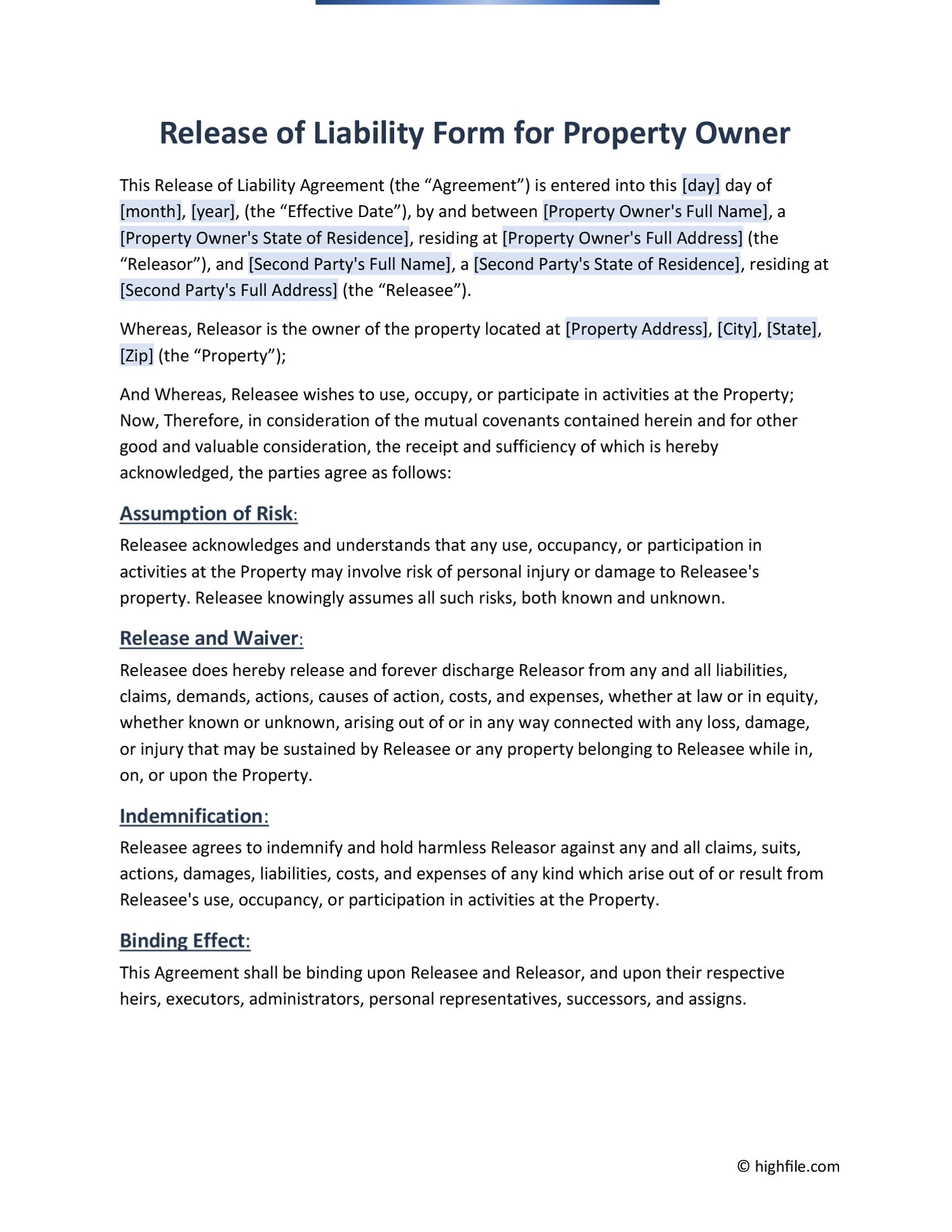




If you own property and someone else will be using, occupying, or participating in activities on it, having a signed liability release in place is one of the most direct ways to protect yourself from legal claims. Injuries, property damage, and unexpected incidents can happen on any property, and without a written agreement, the property owner may be held responsible by default. This Release of Liability Form for Property Owner is designed to formalize that understanding between you (the property owner) and the person who will be using your property. It documents that the second party is aware of the risks involved and voluntarily agrees to waive their right to bring claims against you for any loss, damage, or injury that occurs on the premises.
The form is built around five legal provisions: assumption of risk, release and waiver, indemnification, binding effect, and governing law. Each of these plays a specific role in limiting your exposure as a property owner. Here is a closer look at how to fill in and use each part of this template.
How to Use This Release of Liability Form
Before getting into the individual clauses, you will need to complete the introductory section at the top of the form. This is where you establish who the agreement is between and what property it applies to.
Party and Property Identification
You start by entering the effective date of the agreement (day, month, and year), then fill in the property owner’s full name, state of residence, and full address. The form refers to the property owner as the “Releasor” throughout. Next, you enter the same details for the second party (full name, state of residence, and full address), who is referred to as the “Releasee.” Below that, you provide the full address of the property in question, including the street address, city, state, and zip code. Getting these details right matters because the entire agreement is tied to this specific property and these specific individuals. If the property address or party information is inaccurate, it could weaken the enforceability of the form.
Assumption of Risk
Under this clause, the Releasee acknowledges that using, occupying, or participating in activities at your property may involve risk of personal injury or damage to their belongings. By signing, the Releasee confirms that they knowingly accept all such risks, both known and unknown. This is a foundational clause because it establishes that the second party entered the agreement with full awareness of potential dangers. If a claim were to arise later, this section demonstrates that the Releasee was not misled about the nature of the risks involved.
If the activities taking place on your property carry above-average risk, such as construction work, recreational sports, or events involving heavy equipment, it is worth specifying those activities in the agreement rather than relying solely on general language. Adding a brief description of the intended use gives the assumption of risk clause more weight if it is ever challenged.
Release and Waiver
This is the core liability protection clause. Here, the Releasee agrees to release and forever discharge you (the Releasor) from any and all liabilities, claims, demands, actions, costs, and expenses connected to any loss, damage, or injury sustained by the Releasee or their property while on your premises. The waiver covers claims at law or in equity, and it applies to claims both known and unknown at the time of signing. In plain terms, by signing this section, the Releasee gives up their right to sue you for anything that happens to them or their belongings while they are on your property.
Indemnification
While the release and waiver protects you from being sued by the Releasee directly, the indemnification clause goes a step further. It requires the Releasee to cover your costs if a third-party claim arises because of the Releasee’s use of your property. For example, if the Releasee hosts guests on your property and one of those guests gets injured and sues you, this clause places the financial responsibility on the Releasee. They agree to indemnify and hold you harmless against any claims, suits, actions, damages, liabilities, costs, and expenses of any kind resulting from their use, occupancy, or participation in activities at the property.
Indemnification clauses are not enforceable in every jurisdiction, and some states limit or void them under certain conditions. Before relying on this clause, check the laws in your state or consult a legal professional to confirm that it will hold up if tested.
Binding Effect
This clause confirms that the agreement is binding not just on the two signing parties but also on their respective heirs, executors, administrators, personal representatives, successors, and assigns. The purpose of this language is to prevent a situation where, for example, the Releasee’s family members attempt to bring a claim against you after an incident, arguing that they were not personally bound by the agreement. With this clause in place, the waiver extends beyond the individuals who signed it.
Governing Law
You enter the governing state in this field, which determines whose laws will apply if a dispute arises. Choose the state where the property is located, as courts generally expect liability agreements to be governed by the laws of the jurisdiction where the activity takes place. Both parties then sign at the bottom, with printed names for the Releasor (property owner) and the Releasee (second party) confirming their agreement to all terms.
File Formats and Customization
This template is available in Word, Google Docs, and PDF formats, so you can customize it digitally before printing or fill it in by hand depending on your situation. If your property is used for different types of activities or by different individuals at different times, consider keeping a signed copy on record for each person and each use case rather than relying on a single blanket form. You may also want to add clauses specific to your situation, such as a description of permitted activities, a timeframe for the agreement, or a requirement for the Releasee to carry their own insurance. As with any legal document, having an attorney review your final version before putting it into use is always a good idea.