
Capability Statement Templates
Think of a capability statement as a business resume, the one page a contracting officer or prospective partner skims to decide if you are worth a longer conversation. These capability statement templates give that page a working order, with room for what you do, what you have delivered, and the codes and contacts that let a reader verify and reach you. Start from the one closest to your field and write in the proof that turns a quick read into a shortlist.






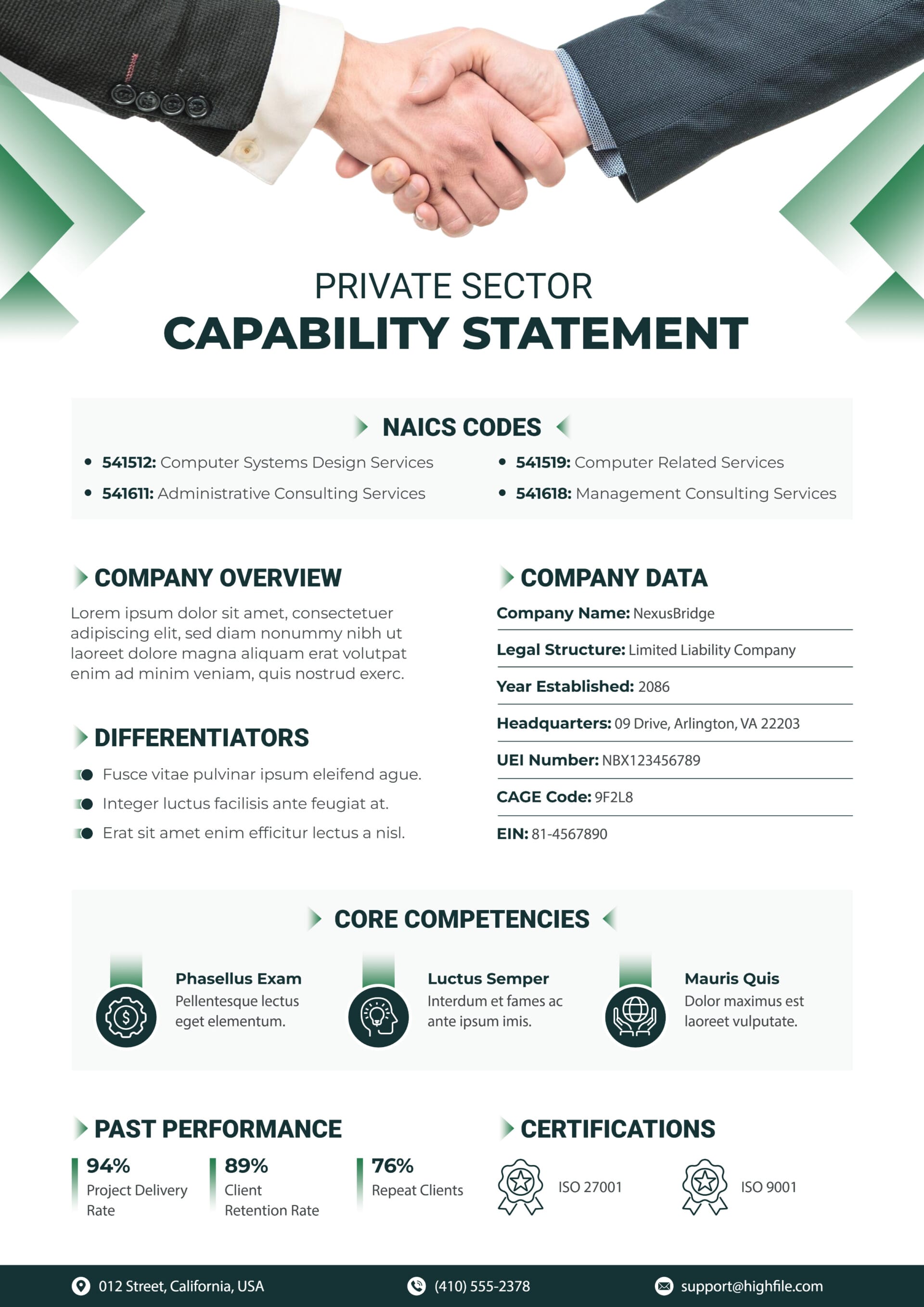


A capability statement is read in seconds, the way a hiring manager reads a resume, scanning for a reason to keep going. It is a one or two page summary of who a company is, what it does well, and why it can be trusted with the work, and it has to land before the reader’s attention moves on. It travels with bids and proposals, gets handed across the table at conferences, and arrives in a procurement officer’s inbox, each time doing the same job of presenting the company quickly and credibly. The point is recognition. A reader should finish it knowing what you offer and believing you can deliver it.
What makes one work is evidence over assertion. Saying a company is experienced means little; naming a comparable contract delivered on time and on budget means a great deal. The reader is often deciding among several statements, frequently against published requirements, so the ones that move forward name real past performance, state competencies in the reader’s terms, and make the company easy to verify and contact. These capability statement templates are built for that read, organized so the proof a decision-maker looks for is where they expect to find it.
Worth knowing: Government buyers often search and shortlist by identifying codes, so listing your NAICS codes alongside DUNS, CAGE, and UEI is not a formality. A missing or wrong code can keep an otherwise strong statement out of the results a contracting officer actually searches.
What goes into a capability statement
The sections a decision-maker reads to judge fit and credibility fast.
A short statement of mission and focus that tells a reader who you are and what you do before they reach the detail.
Your primary services stated in the reader's terms, so a buyer scanning against their requirements recognizes a match quickly.
Completed contracts and projects with measurable outcomes, the evidence that turns a claim of experience into proof of it.
The specialized expertise, certifications, or awards that set you apart, written as reasons to choose you over a comparable competitor.
Legal name, website, contacts, and identifying codes such as DUNS, CAGE, and NAICS, the details a buyer uses to verify and shortlist you.
Optional additions such as testimonials, key personnel, or case studies, added when a specific contract or audience calls for more proof.
Writing a capability statement that gets read
How to make one page earn a place on the shortlist.
Open with what you do for clients like the one reading, stated in their language. A buyer scanning for a fit decides in seconds, so the first lines have to read as relevant to them.
Phrase your core services to match how the reader describes the work, not how you do internally. Recognition is faster when your words echo their requirements.
Replace adjectives with results, a contract value, a timeline met, a percentage improved. Measurable outcomes are what let a reader trust you can repeat them.
Tip — Pick past projects that resemble the work you are pitching for. A relevant smaller job persuades more than a large unrelated one.
Name what genuinely separates you, a certification, a niche capability, a track record competitors lack. Generic strengths anyone could claim do no work here.
List your identifying codes and current contact details accurately. A buyer who cannot verify or reach you may simply move to the next statement in the stack.
Hold one broad version, then sharpen a copy for each opportunity by foregrounding the competencies and projects that match that contract. The most relevant statement usually wins the read.
FAQs
How are these capability statement templates organized?
By the kind of organization presenting itself, so the emphasis already fits the reader. A general business statement keeps a broad summary, a healthcare or community-services one foregrounds the work and outcomes that matter in that field, a vendor statement leans on past performance and codes, and a non-profit one leads with mission and impact. You start from the version closest to your situation and write your own proof into it.
Do these templates include the sections a buyer expects, and can I tailor them per bid?
Yes to both. Each is built around the parts a decision-maker looks for, company overview, core competencies, past performance, differentiators, and company data with room for identifying codes, all on one or two pages. Keep a broad master version, then sharpen a copy for each opportunity by foregrounding the competencies and projects that match that contract, since the most relevant statement usually wins the read.
What are DUNS, CAGE, and NAICS codes, and do I need them?
They are identifiers used in business and government contracting. A NAICS code classifies your industry, a CAGE code identifies your entity to government systems, and a DUNS number was long used for the same. If you pursue government work, include the codes that apply to you, since buyers often search and shortlist by them. For purely commercial use they matter less, though listing relevant ones still reads as professional.
Who uses capability statements?
Small businesses, independent consultants, government contractors, and non-profits all use them, anywhere a brief, credible introduction has to do work in a bid, a pitch, or a networking conversation. They are especially common in government contracting, where buyers expect a standard one-page summary, but any organization presenting itself to a prospective client or partner can use one.