


A 50/50 custody schedule is a parenting-time arrangement in which both parents share time with the child as evenly as possible across a repeating cycle. In day-to-day use, that usually means the child spends a similar number of overnights with each parent over a two-week period, while exchanges follow a pattern that can be repeated throughout the month. Families often consider this kind of arrangement when both parents remain involved in school routines, appointments, activities, and regular care, but the right rotation still depends on details such as the child’s age, school distance, travel time between homes, and how often transitions feel manageable.
This 50/50 custody schedule template is designed for planning and reviewing equal parenting-time arrangements before a regular schedule is finalized. It presents several commonly used 50/50 rotations in one document, including alternating week, 3-3-4-4, 2-2-5-5, 3-4-4-3, and 2-2-3 schedules, with space to identify Parent 01 and Parent 02 and follow each day in the cycle. Using this template, parents can review how each arrangement divides weekdays and weekends, consider how often exchanges would take place, and choose the pattern that best matches school routines, travel between homes, activity schedules, and the child’s everyday life.
Below is a closer look at how to fill it in and how to use each rotation when you are drafting, reviewing, or discussing a parenting-time plan.
Start With the Parent Names
Begin by replacing “Parent 01” and “Parent 02” with the names you want used throughout the schedule. If this document will be shared with attorneys, mediators, school staff, or family members, using names instead of informal labels can reduce confusion. If you are preparing more than one version, keep the naming style the same in every copy so each draft is easier to compare.
Choose the Rotation You Want to Test
This template is especially useful because it shows several equal-time rotations in one place. That gives you room to think beyond the question of equal time and focus on how the pattern actually feels across a school week, a weekend, and a full two-week cycle.
The Alternating Week rotation gives each parent a full week at a time. This can reduce exchanges and may feel easier when homes are farther apart or when school routines need fewer handoffs. At the same time, a full week away from one parent may feel like a long gap for younger children.
The 3-3-4-4 Rotation divides time into shorter blocks at the start of the cycle and longer blocks after that. It can create a rhythm that still feels balanced while keeping children from going too long without seeing either parent.
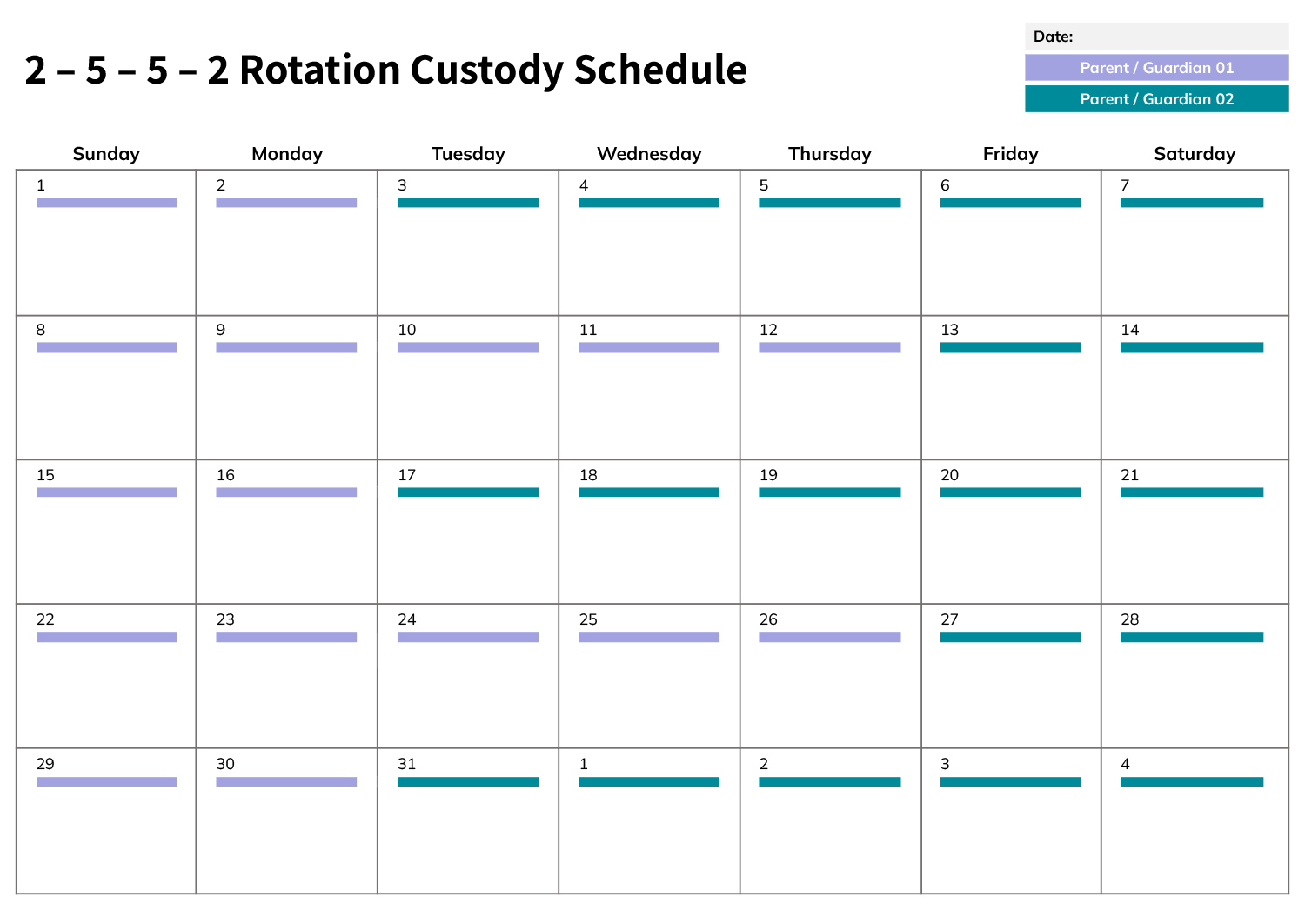
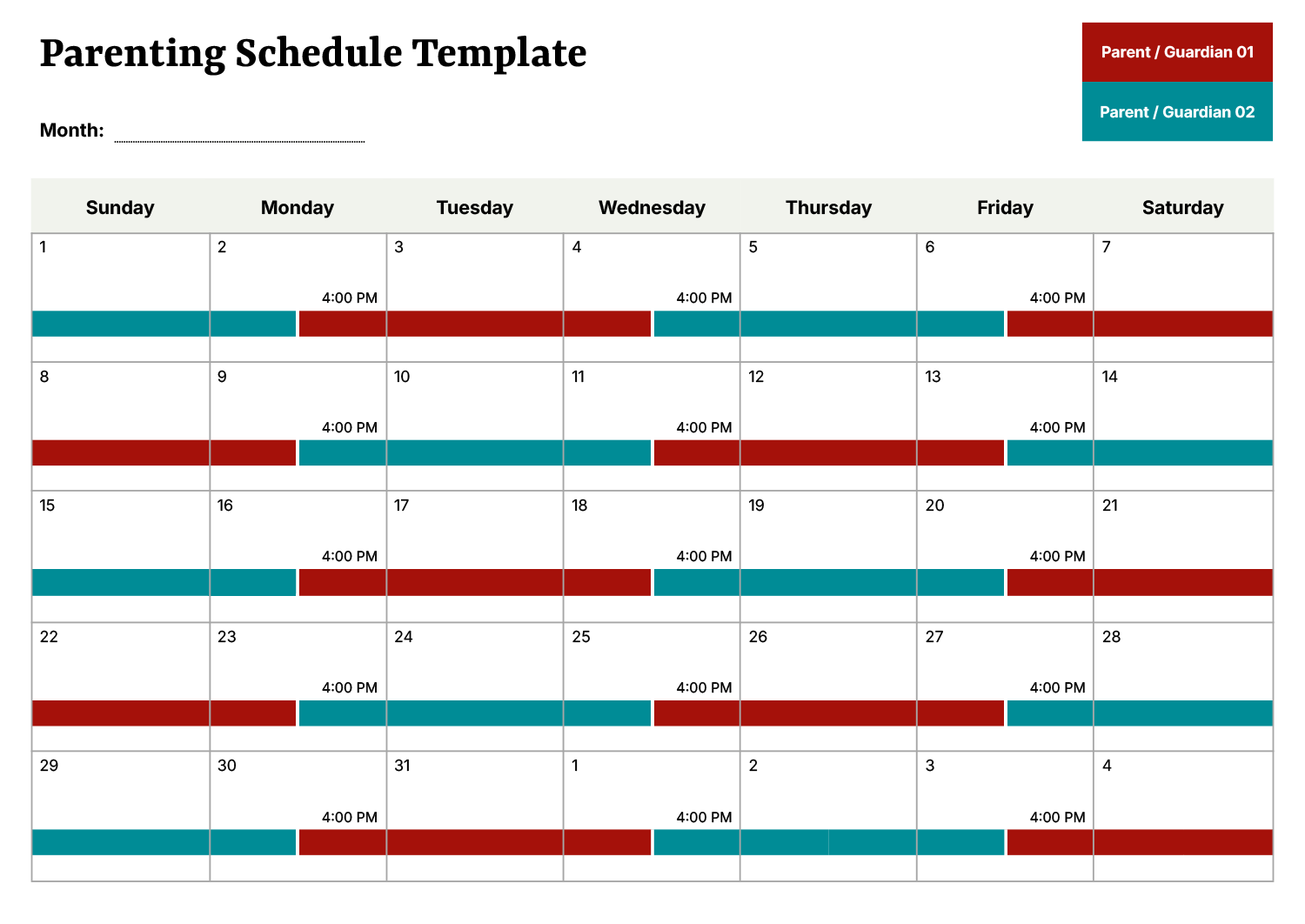
The 2-2-5-5 Rotation is often considered when parents want recurring weekday patterns. For example, one parent may regularly have Monday and Tuesday, while the other has Wednesday and Thursday, and weekends extend into the longer five-day block. That can make school drop-offs, activity nights, and homework routines easier to assign from week to week.
The 3-4-4-3 Rotation also keeps parenting time close to equal, but the handoff pattern lands differently across the week. Some families prefer it because it spreads weekdays and weekends differently than the 2-2-5-5 model.
The 2-2-3 Rotation involves more frequent exchanges. For some families, that means the child sees each parent more often. For others, it can feel tiring if commute time, school packing, or activity schedules already take a lot of coordination.
Mark Which Parent Has Each Day
Once you have chosen a rotation to review, assign one color to each parent and mark the days accordingly. The sample layout already uses color blocks visually, so you can keep that idea and adapt it to your own names and schedule. If you prefer, you can also place initials inside each day box or write “Parent 01” and “Parent 02” directly into the spaces.
When filling in the first row, decide where the cycle begins. That starting point matters because a 2-2-5-5 or 3-4-4-3 plan can look different depending on which parent starts the pattern. If you are testing more than one option, duplicate the file and save each version under a different name so you can compare them later without overwriting your first draft.
You can add the exchange time directly inside the selected day box, place it right underneath the day name, or write it in by hand after printing. Adding the time makes the schedule more complete because the day alone may not fully show when parenting time changes. For example, a Monday exchange at 10:00 a.m. carries a different meaning than Monday after school or Monday in the evening. Keeping the handoff time close to the selected day makes the schedule easier to read and easier to follow during actual exchanges.
Add the Details the Weekly Pattern Does Not Show
A weekly rotation is only part of a parenting plan. Holidays, school breaks, birthdays, vacations, and special events often follow a different schedule. This template can serve as your regular-week calendar, while those exceptions can be added in a second document or written as notes below the chosen rotation.
If a court order, mediation draft, or parenting agreement already exists, use that language as your reference point before editing the calendar. That keeps your visual schedule aligned with the written terms that control exchanges.
Review the Schedule From the Child’s Routine
Before finalizing anything, read through the rotation as a child would live it. Think about school mornings, activity bags, sports gear, medication, bedtime routines, and how often transitions happen during the week. A schedule can look evenly divided on paper but still feel difficult once transportation, homework nights, and midweek exchanges are factored in.
This is also a good point to think about sibling routines. If more than one child is involved and their schedules differ by age, a rotation that looks manageable for one child may create pressure for the other. Testing the calendar against an actual school week often reveals issues that are easy to miss during early planning.
Wrap-Up
This template is available in Word and Google Docs, which gives you room to revise labels, change colors, duplicate drafts, or add notes for holidays and exchange times. You may want to keep one version for regular school weeks and another for summer, travel periods, or temporary arrangements while a longer-term parenting plan is still being discussed. Since the template already presents several equal-time rotations in the same file, it can also be used as a comparison draft before you commit to one repeating pattern.