

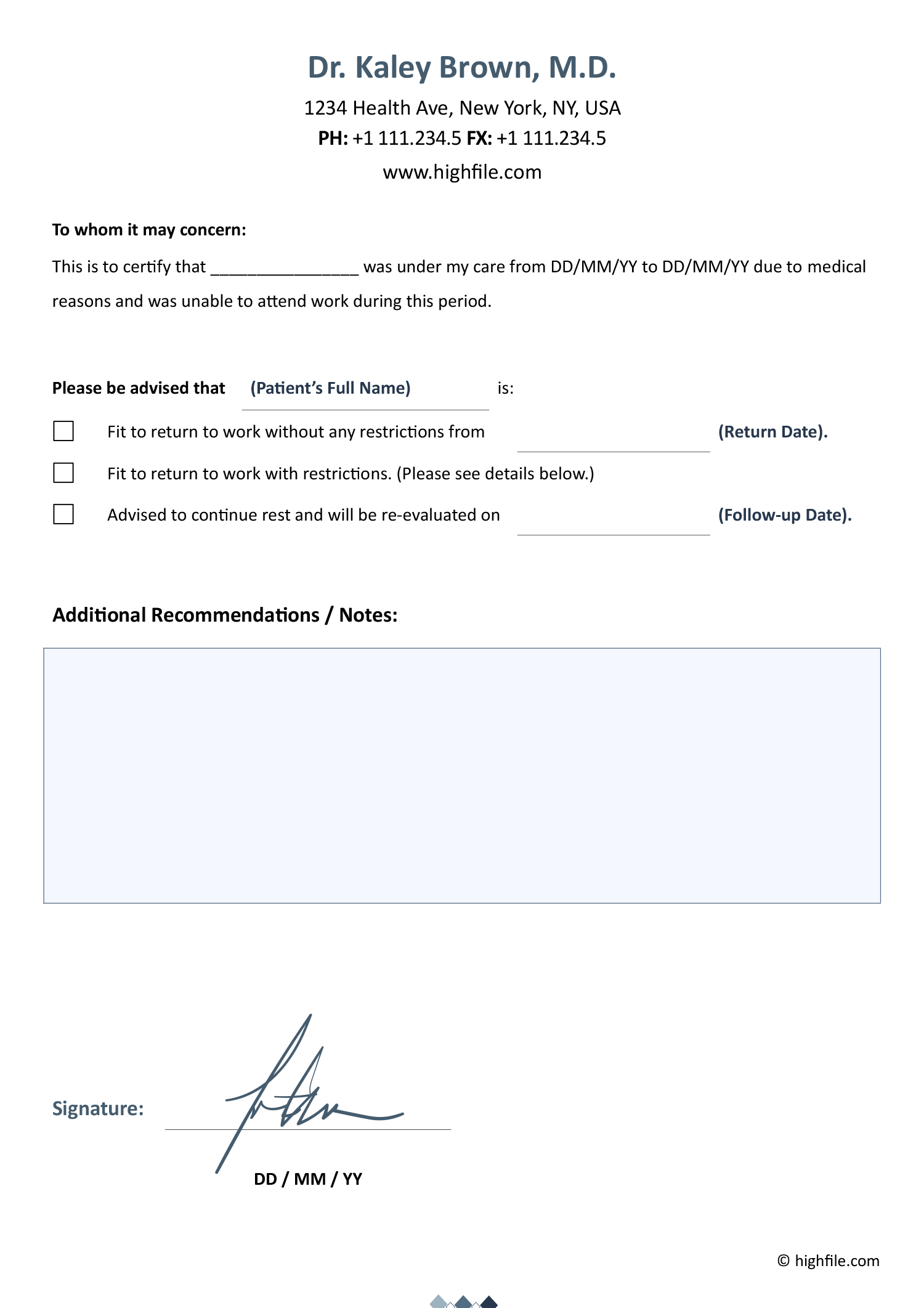
A doctor’s note (sometimes called a medical certificate) is a short document written by a licensed healthcare professional that confirms you were seen, explains why you needed to miss work or school and specifies any limitations or accommodations you need. Employers and schools often require one when you’re absent for multiple days or requesting leave under laws like the Family and Medical Leave Act (FMLA). Knowing how to request and use a doctor’s note correctly protects your job or grades and respects privacy laws like HIPAA.


Getting a Doctor’s Note
Determine if you need a doctor’s note –
Before scheduling an appointment, check if a note is actually required. Many employers don’t ask for documentation unless you’ve been absent for several days or are requesting accommodation under FMLA or the Americans with Disabilities Act (ADA).
- Check your company or school policy. Human-resources handbooks usually state after how many sick days a note is required.
- Common reasons. A note is typically needed for extended illness, chronic conditions causing frequent absences, injuries that prevent you from performing duties, or serious health conditions qualifying for FMLA leave.
- Don’t assume minor illnesses require documentation. Some jurisdictions (e.g., Ontario) discourage doctor’s notes for minor illnesses because they burden the healthcare system.
Gather information your doctor will need –
Collect details about what your employer or school requires so you can communicate them to your healthcare provider. FMLA certifications must include the nature of the medical condition, why leave or accommodation is necessary, how long it is expected to last, and whether intermittent leave is recommended.
- Ask HR or your school for forms. Some employers provide doctor’s note templates that need to be completed; bring them to your appointment.
- Know the privacy rules. Under HIPAA, doctors can only disclose information necessary to justify your absence; they cannot share confidential details without your consent.
- Consider extra documentation. If you’re requesting accommodation for a disability, you may need an FMLA certification or ADA paperwork; plan ahead.
Schedule an appointment with a qualified healthcare provider –
Once you understand the requirements, make an appointment with your primary-care doctor, nurse practitioner, dentist, psychiatrist or another licensed provider.
- Book the earliest available time. Try to schedule soon after you become ill or injured; busy medical offices can cause delays.
- Use walk-in or urgent care for minor issues. If you don’t have a regular doctor or can’t get an appointment, a walk-in clinic or urgent-care center can usually provide a note.
- Consider telemedicine. Telehealth platforms offer virtual visits and can email you a doctor’s note in PDF format. Confirm that your employer accepts telemedicine notes and that the provider is licensed in your state.
Explain your situation during the appointment –
When you meet your doctor, communicate why you need the note and what information it must contain. Being honest helps the doctor document your situation accurately.
- Describe your symptoms and limitations. Provide enough detail for the doctor to determine whether time off or workplace restrictions are necessary.
- Bring any required forms or templates. Showing the doctor your employer’s form ensures that all required fields are completed.
- Request the note in the correct format. Some companies require a typed note, an FMLA certification or a hand-signed letter; clarify what’s needed.
- Respect confidentiality. Tell your doctor not to include sensitive details; a valid note usually lists only the date of visit, a brief description of limitations and the recommended time off.
Make sure your doctor’s note includes the required details –
A proper doctor’s note should verify that you were seen and provide enough information to justify your absence without revealing private medical details.
- Patient information. Your full name and date of birth should be listed.
- Date of visit. The note must show when you were evaluated.
- Description of your condition and restrictions. A brief statement of your symptoms and any work or school restrictions (e.g., no lifting, reduced hours).
- Expected time off. Specific dates you’re excused from work or school and the date you can return.
- Provider’s contact details and signature. The doctor’s name, professional title, signature and contact information for verification.
- Optional FMLA details. For FMLA certifications, additional information about how your condition affects your ability to work and whether intermittent leave is needed may be required.
Submit the note promptly and keep copies –
Once you have the note, give it to your employer or school as soon as possible. Many companies have strict deadlines for submitting medical documentation.
- Follow the submission procedure. Your HR department may require an upload to an employee portal, an email to a specific address or a paper copy.
- Retain a copy. Keep a personal copy of the note in case there are disputes or you need to provide it again.
- Communicate if you can’t get a note. If you are unable to see a doctor, explain the situation to your employer. Many employers will accept documentation from a pharmacist, telehealth provider or urgent-care clinic.
Be prepared for potential challenges and know your rights –
Sometimes, challenges can arise when getting or using a doctor’s note, such as difficulty scheduling an appointment, a provider’s refusal to issue documentation, missing required details in the note, or questions from your employer about its validity. Being aware of these issues will help you handle them effectively.
- If your doctor is reluctant to issue a note. Explain your employer’s requirements. If the doctor still refuses, you may need to seek a second opinion.
- If the note lacks necessary details. Ask your doctor to revise it; provide templates or forms if specific wording is required.
- If there are delays. Schedule appointments early and emphasize the urgency.
- Understand your legal protections. Under FMLA, eligible employees are entitled to job-protected leave for serious medical conditions; employers must keep your medical information confidential. HIPAA restricts what doctors can disclose, and your employer cannot retaliate against you for taking medical leave.
- Never forge or alter a note. Providing false documentation is unethical and can lead to serious consequences, including termination. Always be honest about your condition.
Things You Will Need
- Contact details for your employer or school’s HR office (to ask about policies and submission methods).
- Any forms or templates provided by your employer or school (e.g., FMLA certification forms).
- Identification and insurance information for your medical appointment.
- List of your symptoms, limitations and requested accommodations to discuss with your doctor.
- Payment method or insurance coverage for the medical visit (doctor’s notes are sometimes not covered by insurance and may incur a small fee).
- A secure way to store copies of your note (paper file or electronic scans).
Tips
- Plan ahead. If you anticipate needing time off (for surgery or ongoing treatment), schedule your appointment well in advance so there is ample time to prepare the note.
- Communicate clearly. Give your doctor all relevant details and provide any employer-supplied forms to avoid incomplete notes.
- Use telemedicine wisely. Virtual visits can be convenient, but choose reputable platforms and confirm that your employer accepts telehealth notes.
- Know your company’s policies. Understand when a note is required and how to submit it.
- Protect your privacy. Ask your doctor to include only necessary information and avoid disclosing sensitive details.
- Follow up. If there is a delay in receiving the note or if your employer disputes it, contact your doctor and HR to resolve the issue.
Important
- Do not falsify a doctor’s note. Forging or altering a note is considered unethical and may lead to disciplinary action or termination.
- Avoid unnecessary details. A valid note should confirm you were seen, list any limitations and specify time off; employers are not entitled to your full diagnosis.
- Respect your doctor’s judgment. Physicians must follow professional guidelines: they can only provide information that is accurate, objective and relevant and must obtain your consent before releasing information.
- Don’t wait until the last minute. Delaying your appointment or submission can result in denied leave requests.
- Beware of unlicensed online services. Only obtain notes from licensed healthcare providers; unverified online templates may not be accepted and could be considered fraudulent.
FAQs
Yes. Your employer can verify the doctor’s notes if there are absences from work. If you have been seen by a doctor for an illness or injury and have been given a note to excuse your absence from work, your employer can contact the doctor to verify the notes. Your doctor cannot provide private medical information, but they will say they saw you and issued a note if you allow them to confirm this information.
A doctor’s note does not need to be stamped in most cases. Insurance companies don’t accept stamp signatures, and some doctors don’t have signature stamps. However, it depends on the note and the requirements of the organization the note is being submitted to. If you’re ever unsure whether you need to get a doctor’s note stamped, it’s always best to err on the side of caution and get it signed and stamped. That way, you can be sure that your doctor’s note will be accepted no matter where you submit it.
Note: If you’re wondering whether the note needs a notary stamp, it does not.
If you have a legitimate doctor’s note that states you are too ill to work, your employer typically cannot take disciplinary action against you. This is true even if you have been out sick for an extended period. However, if your employer has reason to believe that your illness is not legitimate or it violates company policy and is not under the protected FMLA, they may take disciplinary action. For example, if you frequently call in sick with no doctor’s note or if your doctor’s note is vague, your employer may suspect that you are abusing the system. In this case, they may take disciplinary action against you.
Anxiety is a real mental health condition that can be debilitating. Regrettably, a doctor can indeed refuse to give you a note for anxiety. There are several factors to consider. For example, if your anxiety interferes with your ability to work or go to school, a doctor may be more likely to give you a note. However, if your anxiety is not severe, a doctor may not feel that a note is necessary and will refuse to issue one. Ultimately, the decision on whether or not to give you a note for anxiety lies with the doctor. If you’re feeling anxious and want a note, it’s best to talk to your doctor about your options.
It is essential to bear in mind that obtaining a note for any medical condition is solely at the discretion of your physician. The specifics of the note you receive will depend on your doctor’s professional judgment, which takes into account their examination, diagnosis, and treatment plan for your condition.
The only way to get a doctor’s note without visiting a doctor is to contact a doctor or other licensed healthcare professionals through a telemedicine/telehealth service. Since these visits are real doctor or healthcare professional visits, the physician who speaks or video chats with you can issue a note for work. However, they have to believe there is a valid reason to do so, or they may refuse, and there are many services telehealth medical professionals cannot offer. Typically, if you require a physical examination, then telehealth isn’t going to work for you.
Not only can you get fired for faking a doctor’s note, but the consequences can also be far worse than job loss. Doctors have medical licenses, and giving a medical diagnosis or note requires this license. If you fake a doctor’s note, you are breaking the law and can be charged. If you want to skip work, use your time off or get a doctor’s note.
While it is generally acceptable for an employer to request a doctor’s note to verify an employee’s illness or absence, the rules surrounding a one-day absence may vary depending on the company policy and local labor laws. Some employers may have a policy in place that does not require a doctor’s note for a single day of absence, while others may have stricter guidelines.
It’s essential for employees to familiarize themselves with their company’s policies on sick leave and medical documentation, as well as any applicable local labor laws. Employers should also ensure that their policies are clear, reasonable, and compliant with legal requirements. In some cases, privacy laws and regulations, such as HIPAA in the United States, may limit the information an employer can request from a healthcare provider. Therefore, both employees and employers must be mindful of these regulations when handling medical documentation.
Yes, a dentist can write a doctor’s note. Dentists are licensed healthcare professionals who specialize in oral health and dental care. They are qualified to diagnose, treat, and manage issues related to the teeth, gums, and mouth. Like other healthcare providers, dentists can issue a doctor’s note to document a patient’s dental condition, treatment, or the need for time off from work or school due to a dental issue.
A dentist’s note may be necessary for various reasons, such as following oral surgery, extensive dental treatment, or when a patient experiences severe dental pain that affects their ability to work or attend school. The note should include essential information, such as the patient’s name, date of the appointment, diagnosis, treatment plan, and any recommended time off or accommodations.
In many cases, yes, you will need a doctor’s note or a letter from a qualified healthcare professional to certify your need for a service dog. A service dog is specially trained to assist individuals with disabilities, such as visual or hearing impairments, mobility challenges, or psychiatric conditions. The doctor’s note, often called a prescription or a letter of recommendation, serves as proof that the service dog is necessary for managing the individual’s disability and enhancing their quality of life.
To obtain a doctor’s note for a service dog, consult your primary care physician, specialist, or mental health professional who is familiar with your medical history and disability. The note should include essential information, such as your name, the specific disability or medical condition you have, and a statement explaining how the service dog will help you manage your disability.
It is important to note that regulations surrounding service dogs may vary depending on the country or jurisdiction you live in, so it is crucial to familiarize yourself with the local laws and guidelines. In the United States, for example, the Americans with Disabilities Act (ADA) protects the rights of individuals with service dogs, but there are specific rules and requirements to be followed.
In certain countries, the government may not offer service dogs to those in need. However, individuals may have the option to explore coverage for service dogs through their personal insurance provider. It is recommended to reach out to your insurance company, should you have one, to inquire about potential coverage for the acquisition, training, and upkeep of a service dog or other types of assistance animals. It is important to keep in mind that specific requirements may need to be met in order to qualify for such assistance.
Yes, urgent care centers can write doctor’s notes. Urgent care facilities provide medical care for non-life-threatening conditions that require prompt attention, such as minor injuries, infections, or other acute health issues. They are staffed by qualified healthcare professionals, including physicians, nurse practitioners, and physician assistants, who are authorized to diagnose, treat, and manage various medical conditions.
When you visit an urgent care center for treatment, you can request a doctor’s note documenting your visit, the diagnosis, any treatments provided, and recommendations for time off or accommodations, if necessary. The note should include essential information, such as your name, the date of the visit, and the healthcare professional’s diagnosis and recommendations.
Your employer does not have to accept a doctor’s note in the US unless it is for FMLA. Although it is usually the policy of most companies to allow legitimately ill or injured employees to take time off if they have a doctor’s note, this is a courtesy and wise business practice, but not a legal requirement.
Yes, many doctors can email a sick note, especially if they offer telehealth services. This can be a convenient option if you are unable to pick up the note in person. Make sure to provide your healthcare provider with the correct email address and check with your employer to see if they accept electronic copies.
Be honest and specific about your symptoms, limitations, and the nature of your job or school responsibilities. Let your doctor know why you believe time off or accommodations are necessary. If your employer provided a form, bring it with you. Avoid exaggeration; your doctor needs accurate details to determine medical necessity.
Authentic notes include the provider’s full name, contact details, license information, and a date of service. Most contain a letterhead, electronic header, or signature. Employers often verify authenticity by contacting the issuing office. Suspicious formatting, errors, or vague language can raise red flags.
References
- U.S. Department of Labor – https://www.dol.gov/agencies/whd/fmla
- U.S. Department of Health and Human Services (HIPAA) – https://www.hhs.gov/hipaa/index.html
- U.S. Department of Justice (ADA) – https://www.ada.gov
- Federation of State Medical Boards – https://www.fsmb.org
- Doctor’s Note Templates – https://www.highfile.com/documents/note-templates/doctors-note/
- Doctor’s Note Wiki – https://www.thedoctorsnote.net/wiki/