


An eye appointment can affect more than the time spent in the clinic. A patient may need time away from work or school after an exam, treatment, dilation, or a follow-up visit. In other cases, the issue is not a full-day absence but a temporary restriction, such as limiting screen use, avoiding driving, or not wearing contact lenses for a certain period. A written note serves as official documentation for an employer, school, or attendance office and may be required before an absence or restriction is accepted.
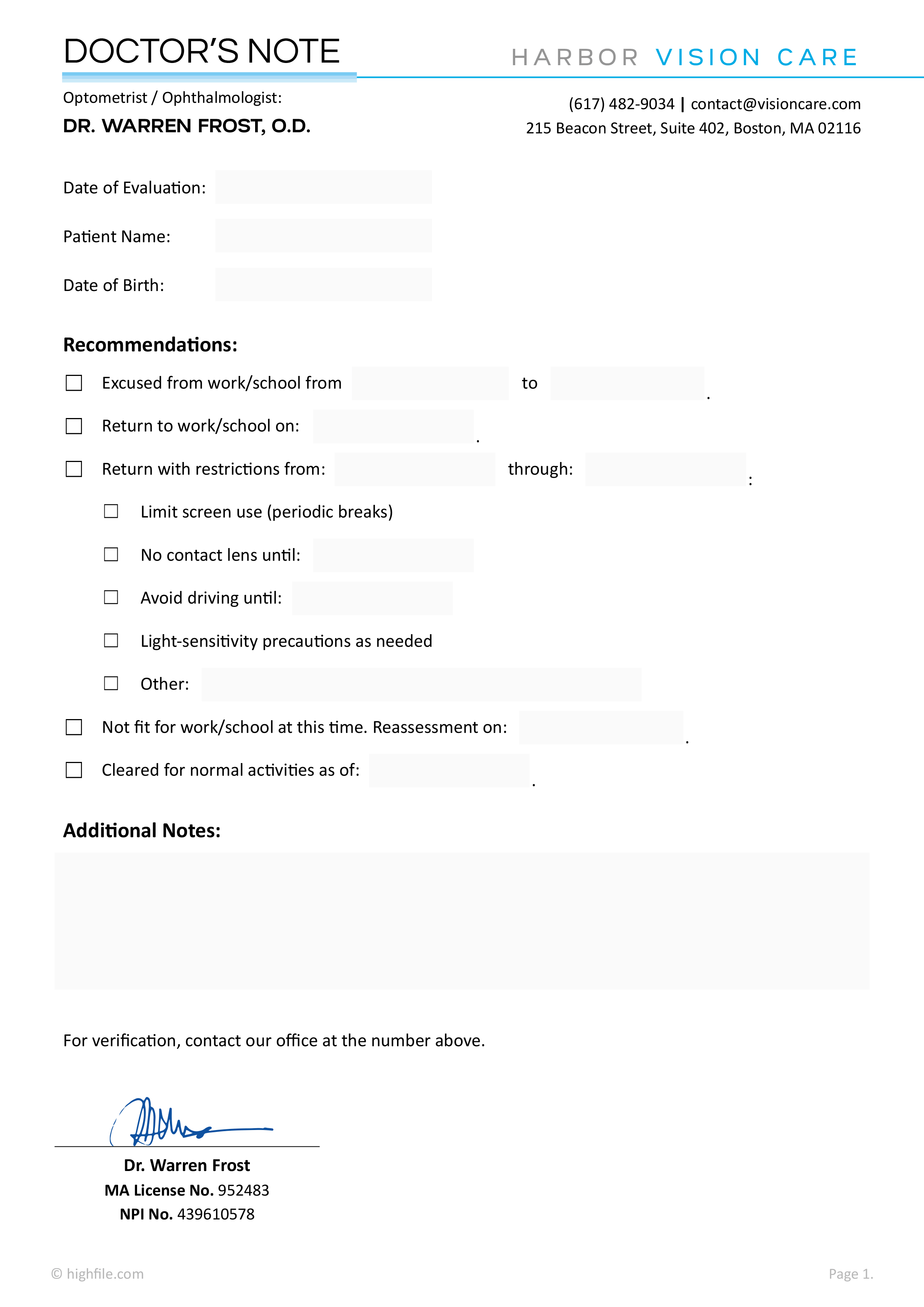
This eye doctor excuse note template is designed for optometrists, ophthalmologists, and eye care clinics that need to confirm a patient visit and issue written documentation for an absence, return date, or temporary restriction. Its content covers clinic and provider details, patient information, the evaluation date, recommendation checkboxes, return-to-work or school guidance, eye-related restriction options, an additional notes section, and verification details. It is suitable for routine eye exams, treatment visits, follow-up appointments, and other situations where attendance and recovery instructions need to be documented together.
Employers, school offices, and attendance departments may review this note, so the wording needs to be direct and easy to understand. The note should present the visit details clearly so the recipient can read, review, and understand them without confusion.
How to Use This Eye Doctor Excuse Note Template
This note should be completed with enough detail to confirm the visit, explain the attendance impact, and record any temporary restrictions that apply after the appointment. Each section serves a specific purpose, so the wording should stay accurate, direct, and easy for the recipient to review.
Clinic Details
Begin with the clinic or hospital name, the provider’s name, and the office contact information. This identifies where the note was issued and gives the recipient a way to verify it if required by an employer, school, or attendance office. For regular office use, this area should be customized first so the note always carries the correct practice information.
Patient Details
Enter the patient’s name, date of birth, and the date of evaluation exactly as they appear in the patient record. These details connect the note to the visit and reduce confusion if the patient has had more than one recent appointment. The evaluation date should reflect the day the patient was seen, even if the absence or restriction continues beyond that date.
Recommendation
Use the recommendation section to record the attendance decision. It can be used to excuse the patient for a stated period, record the date the patient may return, note a return with restrictions, state that the patient is not fit for work or school at the time of evaluation, or confirm the date normal activities may resume. This is especially important in eye care, where a patient may need time away after treatment or may be cleared to return with temporary precautions in place. The wording should match the provider’s actual recommendation and make the attendance status easy for the recipient to understand.
Restrictions
Complete the restriction lines with short, specific instructions. The note includes common eye-related limitations such as limited screen use with periodic breaks, no contact lens wear until a stated date, no driving until a stated date, and light-sensitivity precautions. There is also room for a different instruction if the visit requires it.
The wording in this section should stay practical and precise. In most cases, the recipient does not need a detailed medical explanation. They need to know which restriction applies, when it starts, and when it ends.
Reassessment and Clearance
Not every patient can be fully cleared on the day of evaluation. For that reason, the note includes a line stating that the patient is not fit for work or school at this time, followed by a reassessment date. This is useful when the provider wants to review the patient again before giving full release.
A separate clearance line is also included for visits where the provider is ready to state the date normal activities may resume. Keeping these outcomes separate makes the note easier to understand and avoids uncertainty about the patient’s current status.
Additional Notes
Use this section for details that do not fit the checkbox lines but still need to be shared in writing. That may include a short instruction about follow-up care, a note about temporary difficulty with prolonged reading after dilation, or another attendance-related point tied to the recovery period.
Keep this section brief. It should add useful context, not repeat the patient chart or restate information that already appears elsewhere in the note.
Verification
Finish by completing the provider name, license number, NPI number, and any verification wording included at the end of the note. This part gives the documentation more authority and gives the recipient a clear path for confirmation if their internal policy requires it.
A complete note with provider identification and office contact details is more likely to be accepted without delay than a short statement with no verification information.
Customizing This Template
This eye doctor excuse note template is available in Word and Google Docs and can be fully customized to match the needs of a clinic, hospital, or private practice. The clinic name, provider details, contact information, note wording, and other editable parts can be updated before use, which makes the template suitable for both regular office use and one-time documentation.