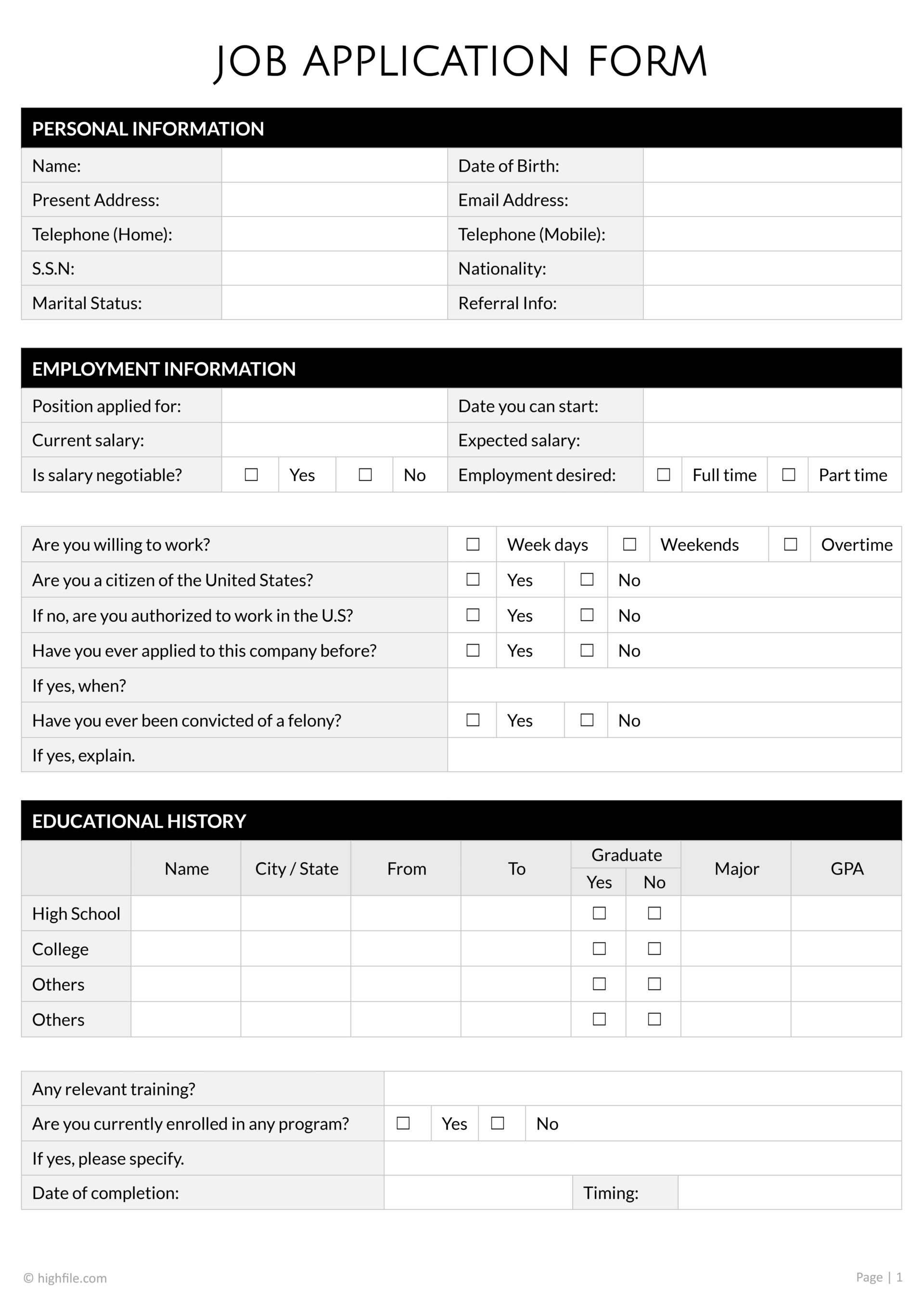




A job application form is used when an employer wants candidate information recorded in a standard hiring format during the first stage of recruitment. This template is designed for employers, hiring managers, and HR teams that need more than a resume and want applicant details entered in one organized form for review. It covers personal information, job interest, availability, education, previous employment, references, acknowledgement statements, and interview notes so each candidate can be reviewed using the same hiring record.
The template follows the order hiring teams often review during screening. It begins with identity and contact details, then moves into employment preferences, academic background, prior work history, and reference information before ending with signature and internal review sections. It can be used for open positions, internal hiring, and pre-interview screening, and sections can be edited or removed based on company policy and local legal requirements. Below is a detailed breakdown of each part of the template and how it should be completed.
Using This Job Application Form Template
The template can be completed digitally or printed for handwritten use. It contains blank entry lines, checkboxes, and labeled spaces for written responses and selections. Employers can expand response areas, shorten sections, or delete items that do not apply to the role. Since the form follows the full hiring sequence, it can be shared during the first application stage or after an initial screening call.
Personal Information
This section records the applicant’s identity and contact details. It includes full name, date of birth, present address, email address, home telephone number, mobile number, Social Security Number, nationality, marital status, and referral information. These entries give the employer a basic record of who the applicant is and how they can be contacted during the hiring process.
Applicants should enter names, dates, and contact details exactly as they appear on official or regularly used records. Phone numbers and email addresses should be current so interview invitations and follow-up messages reach the right person. Items such as Social Security Number, nationality, marital status, and referral source may be removed or left blank if company policy or local rules require that change.

Employment Information
This section records the position the applicant wants and the working terms tied to that role. It includes the position applied for, the date the applicant can start, current salary, expected salary, and a box to mark if salary is negotiable. This gives the employer an early record of timing and pay expectations.
The section also asks about work preferences. Applicants can mark full-time, part-time, temporary, or seasonal work and can indicate availability for weekdays, weekends, and overtime. These selections are useful for roles that involve fixed scheduling or shift-based work.
The final part covers work authorization and prior application history. It asks if the applicant is a citizen of the United States, if the applicant is authorized to work in the U.S., if the applicant has applied to the company before, and if the applicant has ever been convicted of a felony. Space is also provided for short explanations when a response requires more context.

Education History
The educational history section is arranged as a table with rows for high school, college, and additional education. Each row includes space for institution name, city and state, attendance dates, graduation status, major, and GPA. This format keeps academic history in a compact order that is easy to review during screening.
Applicants should complete each row with the most relevant information available. The graduate box can be marked when a program was completed. If a program was not completed, that box can remain blank. The major line should identify the main area of study, and GPA can be entered if the employer requests it or if the applicant wants it included as part of the academic record.
Below the table, the form also asks about relevant training and current enrollment. This part can be used for certifications, short programs, technical training, or coursework that does not fit into the main education rows. If the applicant is currently enrolled in a program, that detail can be written in the space provided along with the expected completion date.

Employment History
This section contains three separate job history blocks so prior roles can be recorded in the same format each time. Each block includes employer name, contact number, job title, a short description of work, supervisor name, reason of leaving, location, contact permission, joining date, relieving date, base salary, and terminal salary.
Applicants should use the work description area to summarize the main duties handled in each role. The wording should stay focused on actual responsibilities tied to the job. The reason of leaving should be brief and factual. Salary entries add useful context by showing the pay level at the start of the role and at the time the applicant left.
Each block also includes a field asking if the employer may contact that company. This is useful when the applicant wants to limit contact with a current employer or does not want a past employer contacted at that stage of hiring.

Military Service
This section applies to applicants with military experience. It includes branch, rank at discharge, joining date, relieving date, type of discharge, and space for a reason if the discharge was not honorable. Employers that review veteran background or service history can use this part as part of the initial applicant record.
If military service does not apply, this section can be skipped. If it does apply, the applicant should enter service details in the same factual style used in the employment history section.
References
The references section is arranged as a table with columns for name, position, company, phone number, email address, and designation. This gives the employer a ready list of professional contacts who can speak about the applicant’s work record, conduct, or qualifications.
Applicants should choose references who know their work in a professional setting and should enter contact details that are current and accurate. Since the table is concise, it works for supervisors, managers, team leads, or other professional contacts.

Acknowledgement
The acknowledgement section contains a series of statements for the applicant to read and accept. These statements cover topics such as the application not guaranteeing a job or interview, permission for background and work history checks, release of liability related to shared information, agreement to follow company rules if hired, and notice that false or incomplete information may affect hiring or later employment status.
This section also asks if the applicant can provide proof of identity and legal right to work in the United States if hired. Since these statements deal with consent and employment terms, they should be reviewed carefully before the form is signed.

Note to Applicants and Signature
This section appears near the end of the form and covers the final statements the applicant should review before submission. It explains that applications are reviewed under applicable employment laws and that the employer follows equal opportunity hiring practices. It also notes that voluntary information may be requested for compliance purposes.
Directly below that, the applicant signs and dates the form to confirm that the information entered is true and complete to the best of their knowledge and that they understand the statements included in the application. For digital submission, the employer may accept a typed name or request a digital signature image. For printed copies, the applicant can sign by hand and enter the date in the space provided.

For Office Use Only
The final section is reserved for the hiring team. It includes fields for interviewer name, interview time, comments, interviewer signature, and date. This keeps interview notes attached to the original application record.
Employers can use this part to record impressions, note follow-up action, or mark the result of the first interview. Since this section is already part of the template, the application and interview record stay together during review.

Customizing the Job Application Form
This job application form template is designed to collect applicant information in a complete hiring format that can be reviewed during screening and retained as part of the recruitment record. It can be edited to match different job types, company policies, and regional rules, and it works for digital completion or printed use. The template is editable in Word and Google Docs, and the spacing can be adjusted if longer responses need more room.