



Releasing an inmate from a correctional facility involves more than unlocking a door. The facility needs a documented record of who is being released, under what conditions, and what the inmate has agreed to comply with after leaving custody. If any of those details are missing or poorly recorded, it creates problems for the facility, the court, and the individual being released. This Jail Release Form is designed to bring all of that information together into a single document that both the inmate and a witness sign at the time of discharge. It is intended for jails, county detention centers, and correctional facilities that process conditional releases, bail releases, or bond releases and need a standardized way to record the details and conditions tied to each one. The form covers facility identification, inmate and case information, specific release conditions, the inmate’s responsibilities while on release, and a formal acknowledgment with a witness signature.
Here is a closer look at how each section of this form is filled in and what it covers.
Facility Identification
The top of the form records the date of release and the details of the correctional facility processing the discharge. You fill in the facility name, street address, city, state, and zip code. This section ties the release to a specific location and date, which matters for record-keeping purposes, especially if the inmate has cases pending in multiple jurisdictions or has been transferred between facilities.
Release Information
This is the most data-dense section of the form, and accuracy here is critical. You enter the inmate’s full name, inmate ID number, date of birth, gender, and race. On the case side, you record the arresting agency, arrest date, offense(s) charged, bail or bond amount, and the bonding company if one is involved. If the inmate has legal representation, the attorney’s name and contact information are also recorded here, along with the scheduled court date.
Every field in this section should be filled in completely. If a field does not apply, such as the bonding company for a cash bail or an attorney for someone representing themselves, marking it as “N/A” is better than leaving it blank. A blank field can look like an oversight during an audit or court review, while “N/A” confirms that the field was considered and intentionally left empty. The court date field is especially worth double-checking because an incorrect date here could lead to a missed appearance, which would trigger a bench warrant regardless of whether the inmate intended to comply.
Release Conditions
This section documents the specific conditions the inmate must follow after being released. The form includes space for up to six conditions, each entered in its own numbered field. The conditions are set by the court or the releasing authority and will vary depending on the charges, the inmate’s history, and the type of release. Common examples include geographic restrictions, curfews, mandatory check-ins with a supervising officer, drug and alcohol testing, electronic monitoring, or no-contact orders.
Below the condition fields, the form states that the inmate must comply with all conditions set by the court or releasing authority, and that failure to do so may result in re-arrest and revocation of release. If the conditions for a particular release exceed six, you can attach a supplemental page and reference it in this section. Keeping the conditions on a standardized form rather than on loose paperwork reduces the risk of conditions being lost or overlooked after the inmate leaves the facility.
Release Responsibilities
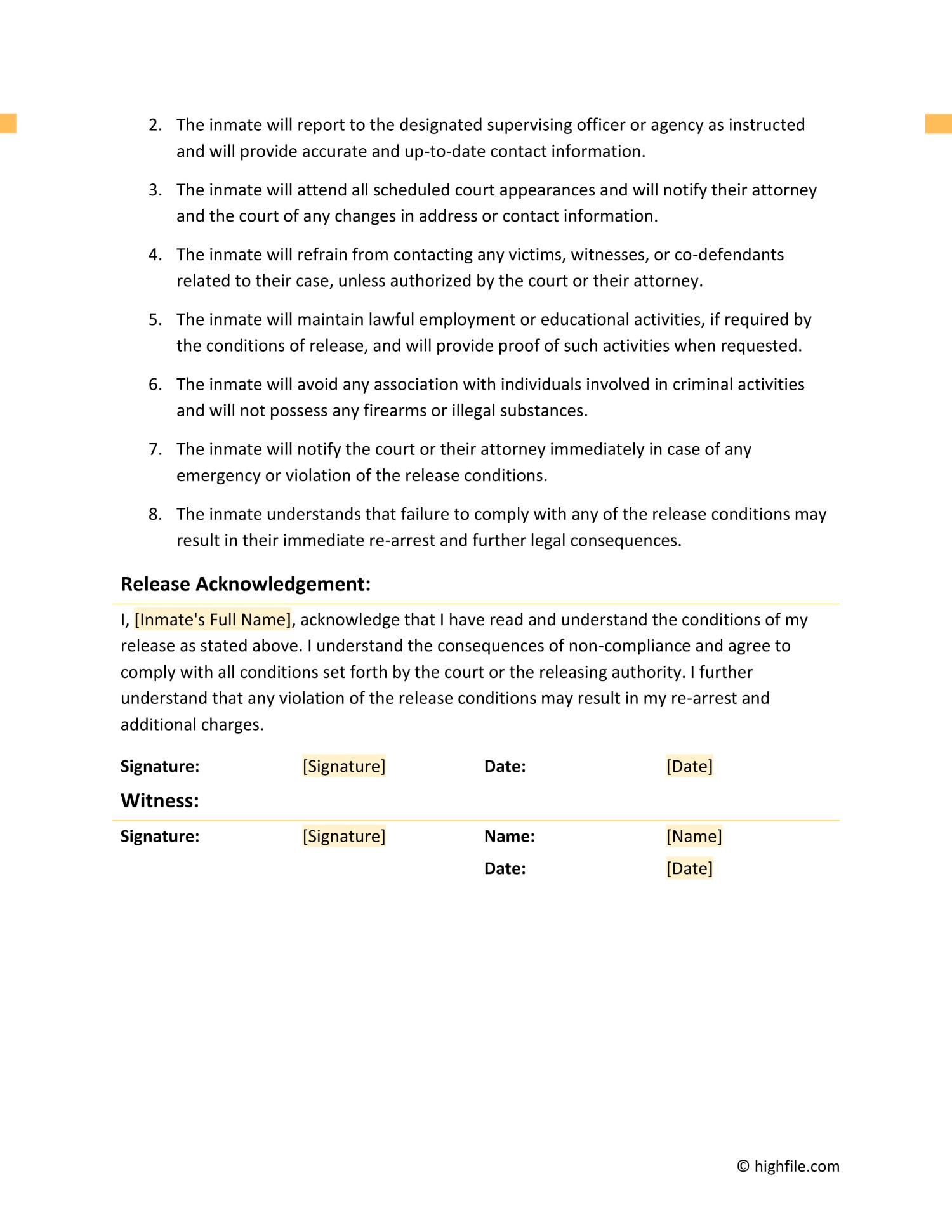
While the conditions section covers court-imposed requirements, the responsibilities section lays out broader behavioral expectations that apply to the inmate during the release period. The form includes eight pre-written responsibilities. The inmate acknowledges that they are responsible for their own actions and will not engage in illegal activities. They agree to report to a supervising officer or agency as instructed and provide accurate contact information. They commit to attending all scheduled court appearances and notifying the court and their attorney of any address or contact changes. Contact with victims, witnesses, or co-defendants related to the case is prohibited unless authorized by the court or an attorney. The inmate agrees to maintain lawful employment or educational activity if required and provide proof when requested. Association with individuals involved in criminal activity is prohibited, and possession of firearms or illegal substances is not permitted. The inmate also agrees to notify the court or their attorney immediately if any emergency or violation occurs. Finally, the form restates that failure to comply with any of these responsibilities may result in immediate re-arrest and further legal consequences.
These responsibilities are written in standard language that applies broadly to most conditional releases. If your facility requires additional responsibilities specific to certain offense categories, such as mandatory treatment program attendance for substance-related charges or GPS monitoring compliance for domestic cases, those can be added to the form before it is used.
Release Acknowledgment and Signatures
The final section is where the inmate formally acknowledges that they have read and understood the conditions and responsibilities above. The acknowledgment statement confirms that the inmate understands the consequences of non-compliance, agrees to follow all conditions set by the court or releasing authority, and recognizes that any violation may lead to re-arrest and additional charges. The inmate signs and dates the form.
A witness also signs below with their printed name and date. The witness is typically a correctional officer or facility staff member present during the release process. This witness signature is not a formality; it confirms that the inmate was given the opportunity to review the conditions and signed the form voluntarily. If the inmate’s compliance is later questioned in court, the witness can verify the circumstances under which the acknowledgment was signed.
Customizing the Jail Release Form
This template is available in Word, Google Docs, and PDF formats. The Word and Google Docs versions can be edited to match your facility’s specific requirements before printing, which is useful if you need to add your facility’s logo, modify the number of condition fields, or include additional responsibility clauses for certain types of releases. For facilities processing a high volume of releases, consider pre-filling the facility identification section and printing a batch of partially completed forms to save processing time at discharge. Each completed form should be copied so that the inmate receives one copy, the facility retains one for its records, and an additional copy can be forwarded to the court or supervising agency if required by local procedure.
FAQs
Yes. The form includes a bail/bond amount field and a bonding company field, but both can be marked as “N/A” for releases that do not involve bail, such as releases on personal recognizance or time-served discharges. The rest of the form applies regardless of the release type.
If an inmate refuses to sign, the facility should document the refusal on the form itself, noting the date, time, and the name of the officer present. The conditions and responsibilities still apply as ordered by the court, but the unsigned form becomes a record that the inmate was informed and chose not to acknowledge in writing.
Yes. The conditions entered on this form should reflect the court’s order verbatim or as closely as possible. If there is a discrepancy between what appears on this form and what the court ordered, the court’s order takes legal precedence. Keeping them aligned prevents confusion for the inmate, the supervising officer, and the court.
The witness is usually the correctional officer or administrative staff member who processes the release. The witness does not need to be a notary; their role is to confirm that the inmate reviewed the form and signed it in their presence. Some facilities may require a supervisor to serve as witness for higher-profile releases.